
Position:Home >
Monocrotaline-induced pulmonary hypertension model
Monocrotaline-induced pulmonary hypertension model
Background
Pulmonary arterial hypertension (PAH) is a progressive and fatal pathophysiological syndrome caused by abnormal remodeling or constriction of small pulmonary vessels due to various factors, leading to increased pulmonary vascular resistance.
Although lung disease is the primary lesion causing PAH, sustained excessive pressure overload results in right ventricular hypertrophy, dilatation, and right heart failure.
Monocrotaline is a pyrrolizidine alkaloid. After being metabolized by hepatic P450 monooxygenases, it enters the circulation and reaches the lungs, where it selectively injures pulmonary vascular endothelium and induces chronic vasculitis, closely mimicking the clinical pathogenesis of PAH.
Therefore, monocrotaline induction represents an ideal method for establishing pulmonary hypertension models.
Materials and methods
- **Animals**: Male SD rats, 6–8 weeks old
- **Model establishment**: A single intraperitoneal injection of monocrotaline was used to establish the pulmonary hypertension model. The model was successfully established 4 weeks after modeling.
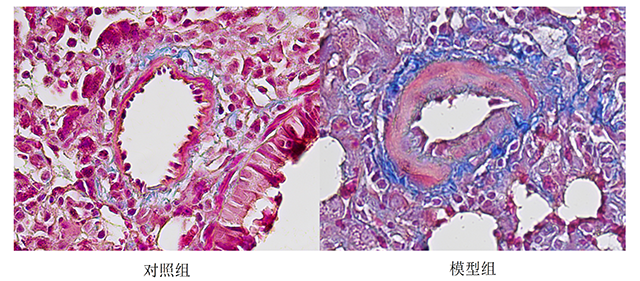
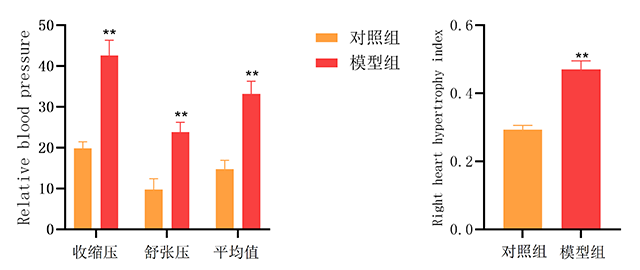
- **Evaluation indexes**: Pulmonary artery pressure, right ventricular hypertrophy index, H&E staining, Masson staining
- **Model establishment**: A single intraperitoneal injection of monocrotaline was used to establish the pulmonary hypertension model. The model was successfully established 4 weeks after modeling.
- **Evaluation indexes**: Pulmonary artery pressure, right ventricular hypertrophy index, H&E staining, Masson staining
Test and verify
Pulmonary artery pressure and right ventricular hypertrophy index
Lung tissue H&E staining

Lung tissue Masson staining