Position:Home >
DNFB-Induced Delayed-Type Hypersensitivity (DTH) Mouse Model with Dexamethasone Therapeutic Positive Control
DNFB-Induced Delayed-Type Hypersensitivity (DTH) Mouse Model with Dexamethasone Therapeutic Positive Control
Background
The DNFB-induced delayed-type hypersensitivity (DTH) mouse model is a classic gold-standard type IV cell-mediated hypersensitivity model in pharmacology and immunology, specifically applied to evaluate the in vivo anti-inflammatory, immunosuppressive and anti-hypersensitivity efficacy of drugs. As a potent small-molecule hapten, 2,4-dinitrofluorobenzene (DNFB) binds to cutaneous tissue proteins after primary abdominal skin application to form complete antigens, sensitizing T lymphocytes and establishing specific immune memory. Secondary ear challenge after a 5-day interval rapidly triggers typical delayed-type hypersensitivity, characterized by ear redness, swelling, thickening, edema and extensive inflammatory infiltration. Dominated by Th1 cell-mediated immune inflammation, this model perfectly simulates the pathological process of clinical contact dermatitis and cell-mediated allergic inflammation. As a classic broad-spectrum glucocorticoid, dexamethasone inhibits the NF-κB inflammatory pathway, downregulates pro-inflammatory cytokines such as IL-2 and TNF-α, and suppresses T cell activation and inflammatory infiltration, effectively alleviating DTH-induced ear swelling and local inflammation. It serves as the authoritative systemic positive control drug for this model.
Materials and methods
SPF-grade BALB/c mice aged 6–8 weeks with body weight of 18–22 g are used, and male mice are preferred. BALB/c mice present stable immune responses, high sensitivity to DNFB-induced type IV hypersensitivity, uniform ear swelling phenotypes and minor group differences, which is the optimal strain for DTH modeling.
Test and verify
Modeling Success Criteria
Ear Swelling Degree
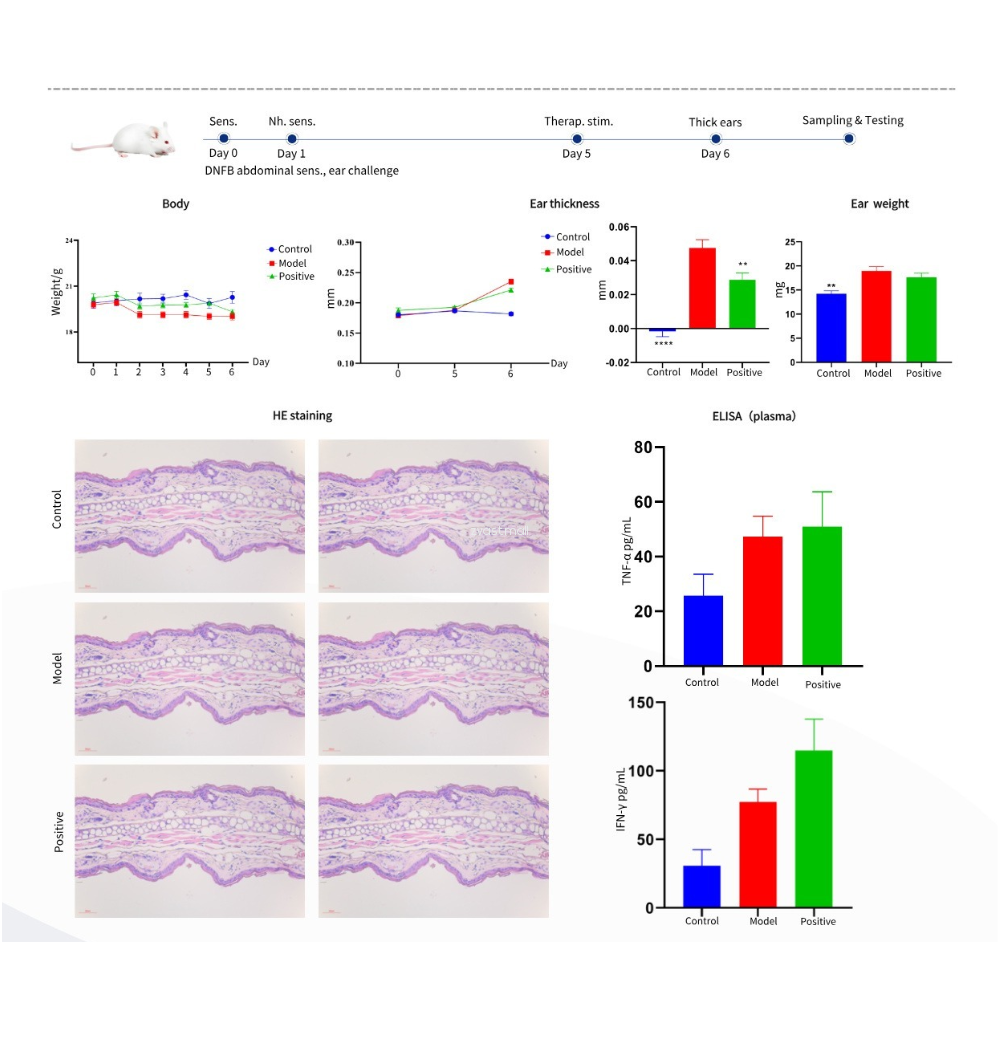
The ear thickness of the model group is significantly higher than that of the blank group with obvious ear redness, congestion and edema, showing statistically significant swelling difference. The positive control group presents significantly reduced ear swelling and relieved inflammation compared with the model group.
Macroscopic Lesion Scoring
Four indexes including ear erythema, edema, congestion and skin thickening are scored from 0 to 3 points for each item, with a total score of 0–12 points. The model group shows significantly increased scores, while the positive control group presents remarkably decreased scores.
Histopathological Characteristics
HE staining of model ear tissues shows epidermal thickening, dermal edema, vasodilation and congestion, and extensive diffuse infiltration of lymphocytes and inflammatory cells, consistent with typical pathological features of type IV delayed hypersensitivity. The positive control group exhibits significantly reduced inflammatory infiltration and relieved tissue edema and hyperplasia.
Immune and Inflammatory Indexes
The levels of Th1-type pro-inflammatory cytokines including TNF-α, IL-2, IL-6 and IFN-γ in serum and ear tissues of the model group are significantly upregulated. The positive control group shows significantly inhibited expression of the above pro-inflammatory factors and attenuated cell-mediated inflammatory responses after dexamethasone intervention.
Model Advantages
As a classic gold-standard model of type IV cell-mediated hypersensitivity, this model features a single specific mechanism and minimal humoral immune interference. It has a short 7-day modeling cycle, simple operation, no surgical trauma, extremely low mortality and excellent reproducibility. The intuitive ear swelling phenotype and accurate quantitative indexes ensure significant statistical differences. With stable dexamethasone systemic therapeutic efficacy, it is an authoritative classic model for evaluating in vivo cellular immunosuppression, anti-inflammatory and anti-hypersensitivity activities, suitable for the preliminary screening and mechanistic verification of traditional Chinese medicines, natural products and small-molecule anti-inflammatory drugs.
Research Applications
The DNFB-induced delayed-type hypersensitivity (DTH) mouse model with dexamethasone positive control is mainly used for the research of type IV hypersensitivity pathogenesis, cellular immune activation and regulation, and acute contact inflammation mechanism. It is specially applied to screen and verify candidate drugs with cellular immunosuppressive, anti-inflammatory and anti-hypersensitivity effects, serving as a basic core standard model for pharmacological and immunological experiments, new drug preliminary screening and anti-inflammatory immune regulation research.