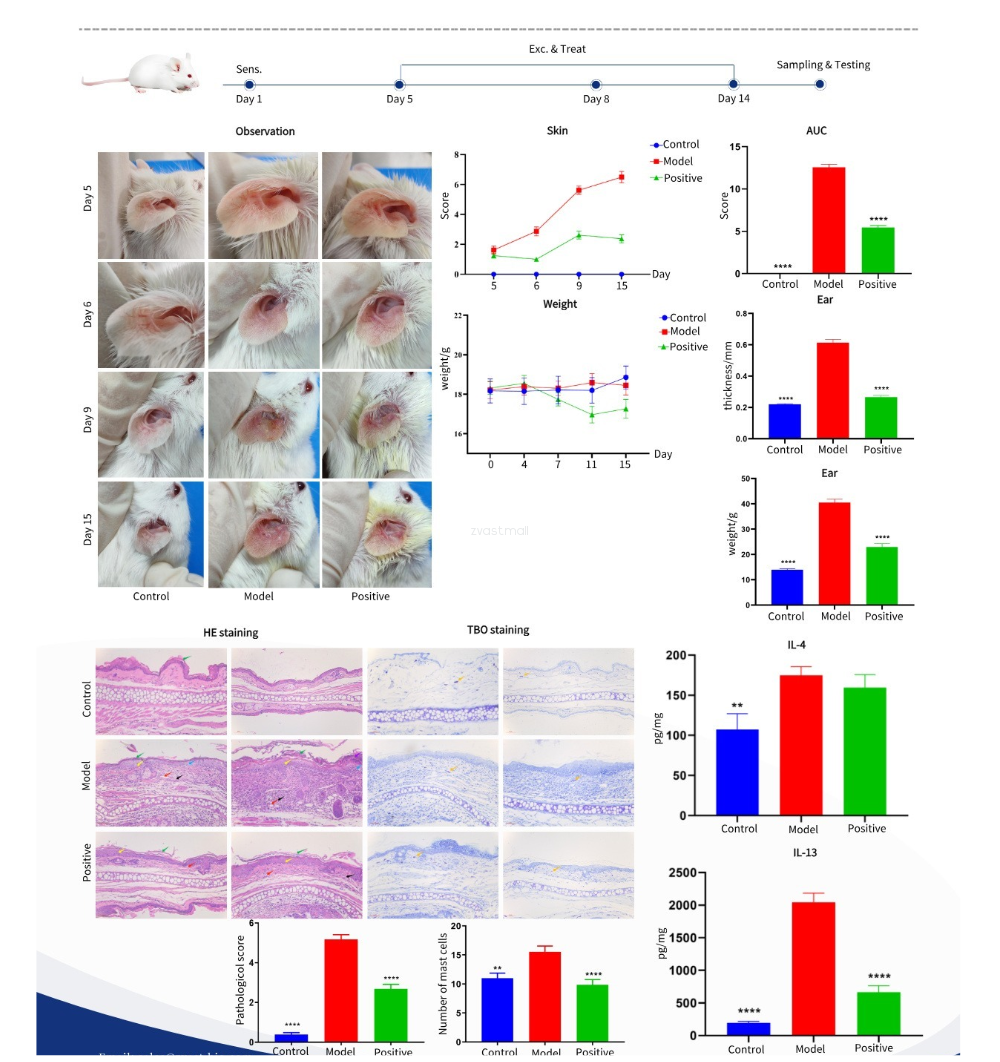
The DNFB-induced atopic dermatitis (AD) mouse model with hydrocortisone butyrate cream positive control is a widely recognized gold-standard topical intervention model for dermatological research, allergic skin disease mechanism exploration, and anti-pruritic drug screening. As a potent small-molecule hapten, 2,4-dinitrofluorobenzene (DNFB) penetrates the skin and covalently binds to cutaneous tissue proteins to form complete antigens, breaking skin immune tolerance and damaging stratum corneum barrier structure. Through primary sensitization and repeated topical challenge, DNFB continuously activates keratinocytes, mast cells and lymphocyte infiltration, induces significant Th2/Th17-skewed immune inflammation, and upregulates the release of IgE, IL-4, IL-5, IL-17, TNF-α and other inflammatory mediators. It stably triggers typical chronic recurrent AD phenotypes including erythema, papules, scaling, skin hypertrophy, lichenification and severe pruritus. 0.1% hydrocortisone butyrate cream is a first-line intermediate-potency topical glucocorticoid in clinical practice. It inhibits core NF-κB and MAPK inflammatory signaling cascades, relieves epidermal hyperplasia and inflammatory infiltration, repairs damaged skin barrier, and efficiently ameliorates AD lesions and pruritus, serving as the classic and authoritative topical positive control for preclinical AD topical drug evaluation.
SPF-grade BALB/c mice aged 6–8 weeks with body weight of 18–22 g are used, and male mice are preferred. BALB/c mice are inherently prone to Th2 immune responses, with high sensitivity to DNFB chemical sensitization, uniform and stable AD lesions, and minor individual differences, which is the optimal strain for atopic dermatitis modeling
DNFB-induced atopic dermatitis mouse model,hydrocortisone butyrate cream topical treatment model,Th2-skewed allergic skin inflammation,skin barrier dysfunction pruritus model
Modeling Success Criteria
Macroscopic Lesion Scoring
Six evaluation indexes including erythema, dry scaling, papules, skin infiltration and hypertrophy, crusting and erosion are scored from 0 to 3 points for each item, with a total score ranging from 0 to 12 points. The total lesion score of the model group is ≥6 points and significantly higher than that of the blank group. The positive control group shows remarkably decreased lesion scores and relieved skin symptoms, confirming successful modeling and effective drug intervention.
Skin Barrier and Edema Indexes
The model group shows significantly increased auricle thickness, elevated transepidermal water loss (TEWL) and decreased skin moisture content, indicating severe skin barrier damage. The positive control group presents relieved auricle edema, reduced TEWL and recovered skin moisture content, suggesting effective barrier function repair.
Histopathological Characteristics
HE staining of the model group shows epidermal hyperkeratosis, parakeratosis, obvious acanthosis, dermal edema, vasodilation and congestion, and extensive diffuse infiltration of lymphocytes and mast cells. The positive control group exhibits significantly improved epidermal hyperplasia and keratinization abnormality, as well as reduced dermal inflammatory infiltration and relieved inflammatory damage.
Immune and Inflammatory Indexes
The model group shows significantly upregulated levels of IgE and Th2/Th17 inflammatory cytokines (IL-4, IL-5, IL-17, TNF-α) in serum and skin tissues, and downregulated expression of skin barrier proteins (Filaggrin, Loricrin). The positive control group significantly reverses the above abnormalities, inhibits Th2 immune imbalance and repairs skin barrier function.
Mice in the model group show significantly increased pruritic behaviors such as spontaneous scratching, lesion licking and restlessness. The positive control group presents remarkably reduced pruritic behaviors and improved mental state and activity.
Established by DNFB chemical sensitization and challenge, this model highly simulates the core pathological features of clinical atopic dermatitis, including skin barrier damage, Th2 allergic inflammation and recurrent chronic pruritus. It features mature modeling procedures, over 95% modeling success rate, excellent reproducibility and minor individual differences. Adopting clinical first-line 0.1% hydrocortisone butyrate cream as the topical positive control with stable intervention efficacy and high academic recognition, it is perfectly suitable for the screening and mechanistic verification of novel topical drugs with anti-inflammatory, anti-pruritic and barrier-repairing effects. With no surgical trauma, extremely low mortality and moderate experimental cycle, it is the preferred topical intervention AD model for dermatological SCI research.
The DNFB-induced atopic dermatitis mouse model with hydrocortisone butyrate topical positive control is widely used in the research of Th2 immune imbalance, skin barrier repair and chronic allergic pruritus mechanisms of atopic dermatitis. It is specially applicable to the pharmacodynamic evaluation of topical skin preparations such as ointments, gels, creams and sprays, and the screening of traditional Chinese medicines, natural products and small-molecule chemicals with anti-inflammatory, anti-allergic, anti-pruritus and barrier-repairing effects. It is also used for preclinical efficacy comparison and mechanistic verification of novel glucocorticoid substitutes and non-hormonal targeted anti-inflammatory agents, serving as a core standard model for the research and development of dermatological topical drugs.