Position:Home  >   DNFB-Induced Atopic Dermatitis (AD) Mouse Model (with Dexamethasone Acetate Positive Control)

DNFB-Induced Atopic Dermatitis (AD) Mouse Model (with Dexamethasone Acetate Positive Control)

Background
DNFB (2,4-dinitrofluorobenzene) is a potent hapten that disrupts the skin barrier and triggers Th2-skewed immune dysregulation upon repeated topical application, inducing hallmark AD features: erythema, scaling, thickening, and pruritus. Dexamethasone acetate (DA), an intermediate-acting glucocorticoid, acts by inhibiting NF-κB/MAPK pathways, suppressing IL-4/IL-5/IL-17 and IgE, and rapidly alleviating inflammation, pruritus, and barrier damage—making it the gold-standard positive control for AD models.
Materials and methods
SPF-grade BALB/c mice aged 6–8 weeks with body weight of 18–22 g are used. Male mice are preferred due to stable hormone levels and uniform modeling phenotypes. All mice are housed in an SPF barrier system with 12 h light/dark cycle, constant temperature and humidity, and ad libitum access to food and water. Formal experiments start after 7 days of adaptive feeding.
Test and verify

Modeling Success Criteria


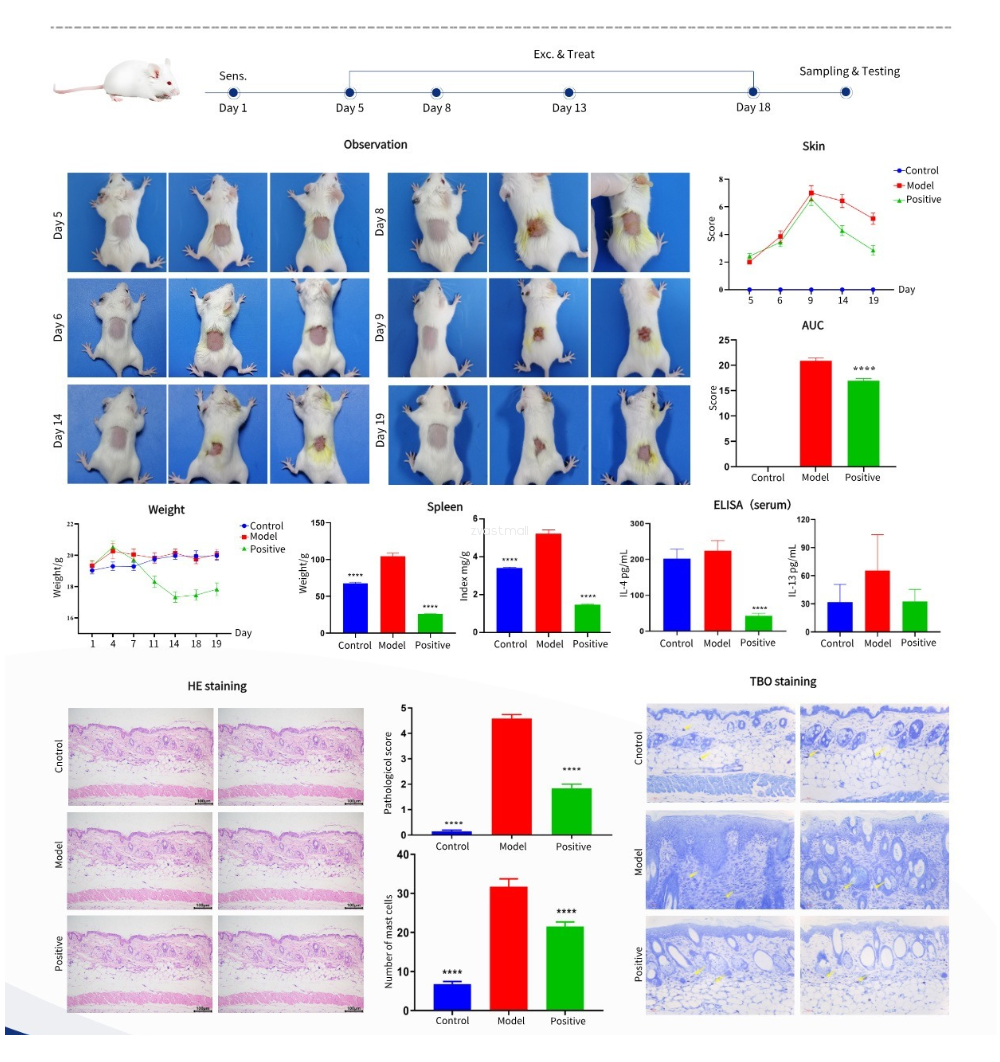
Macroscopic Lesion Scoring


Scoring items: erythema, dry scaling, papules, infiltration and thickening, crusting, erosion. Each item is scored from 0 to 3 points, with a total score ranging from 0 to 12 points.

Success criteria: The total lesion score of the model group is ≥ 6 points and significantly higher than that of the blank group. The lesion score of the positive control group is obviously decreased compared with the model group.


Histopathology (HE staining)


Model group: Epidermal thickening, hyperkeratosis, parakeratosis and acanthosis are observed, accompanied by dermal edema, vasodilation and massive infiltration of lymphocytes, mast cells and other inflammatory cells.

Positive control group: Attenuated epidermal hyperplasia and markedly reduced dermal inflammatory cell infiltration.


 Immunological Indexes


In the model group, the levels of IgE, IL-4, IL-5, IL-17 and TNF-α in serum and skin tissues are significantly increased, while the expression of skin barrier proteins Filaggrin and Loricrin is downregulated. The above indexes are obviously reversed in the positive control group.


Behavioral Performance


Mice in the model group show frequent scratching and licking on lesion areas with restlessness. Pruritus-related behaviors are remarkably alleviated in the positive control group.


Advantages


  • The pathological features are clinically relevant, which can simulate core lesions of atopic dermatitis such as skin barrier damage and allergic Th2-type inflammation;
  • BALB/c mice present stable sensitization response with modeling success rate over 95% and good reproducibility;
  • The positive control drug has definite efficacy, which can effectively distinguish drug effects;
  • Moderate modeling cycle, suitable for drug screening and mechanism research.

  • Application Scenarios


    It is applied to the research on the mechanism of Th2/Th17 immune imbalance and skin barrier damage in atopic dermatitis. It is used for efficacy screening and target verification of traditional Chinese medicines, natural products and chemical small-molecule drugs with anti-inflammatory, anti-pruritus and barrier-repairing effects. It is also available for preclinical efficacy evaluation of glucocorticoid substitutes and targeted anti-inflammatory agents.