Position:Home >
Der f Combined with SEB-Induced Atopic Dermatitis (AD) Mouse Model
Der f Combined with SEB-Induced Atopic Dermatitis (AD) Mouse Model
Background
The Der f combined with SEB-induced atopic dermatitis (AD) mouse model is a clinically highly-relevant animal model for simulating chronic recurrent atopic dermatitis. The skin lesions of AD patients are often colonized by Staphylococcus aureus, and SEB (Staphylococcal Enterotoxin B) is a critical exacerbating factor for inflammation, pruritus and disease recurrence. In this model, Dermatophagoides farinae (Der f) acts as the initial sensitizer to disrupt the skin barrier, activate cutaneous innate immunity, induce Th2-skewed immune responses, and establish chronic allergic skin inflammation. Subsequent local stimulation with Staphylococcal Enterotoxin B (SEB) further amplifies inflammatory cascades, breaks immune tolerance, and triggers Th2/Th17 inflammatory storms, resulting in typical AD-like lesions including erythema, scaling, crusting, dryness, skin hypertrophy and severe pruritus. This model faithfully recapitulates the clinical AD pathogenesis of “skin barrier damage + dust mite sensitization + bacterial toxin-induced inflammation aggravation”.
Der f-SEB induced atopic dermatitis mouse model,house dust mite allergen skin inflammation,Staphylococcal Enterotoxin B aggravated AD model
Materials and methods
SPF-grade BALB/c mice aged 6–8 weeks with body weight of 18–22 g are used. BALB/c mice are highly sensitive to dust mite allergens and prone to strong Th2 immune responses, making them the optimal strain for atopic dermatitis modeling. All mice are adaptively raised for one week under SPF conditions with 12 h light/dark cycle and ad libitum food and water to avoid exogenous allergen interference.
Test and verify
Modeling Success Criteria
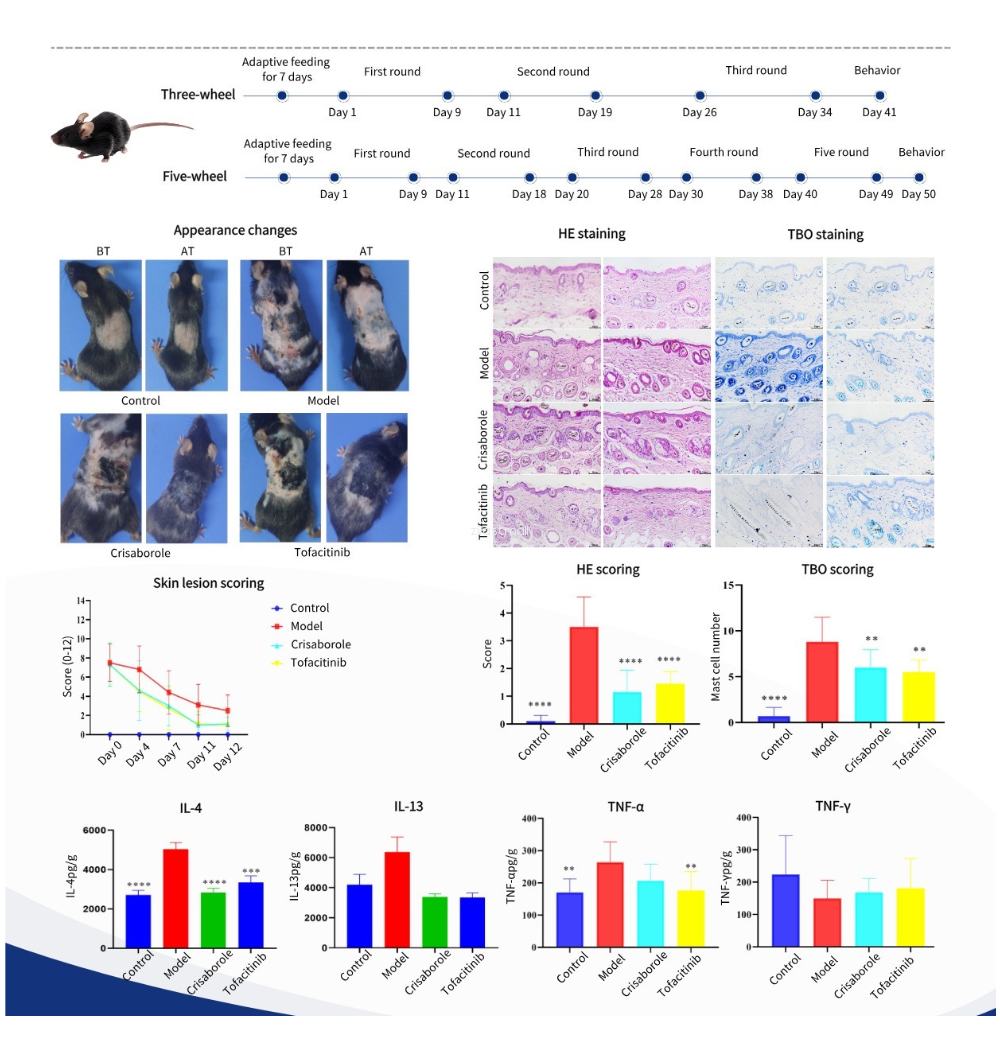
Model mice exhibit frequent scratching and licking of dorsal skin, significantly increased spontaneous pruritic behaviors and restlessness, consistent with typical AD pruritus manifestations.
Model skin presents obvious erythema, dry scaling, papules, infiltration and hypertrophy, crusting and erosion with significantly higher skin lesion scores than the control group. The skin shows roughness, decreased elasticity and deepened texture, indicating chronic skin remodeling.
HE staining reveals epidermal thickening, hyperkeratosis, parakeratosis, acanthosis, dermal edema and extensive inflammatory infiltration. Increased mast cell infiltration is observed, consistent with classic AD pathological changes.
Significant upregulation of IgE, IL-4, IL-5, IL-13 and IL-17 in serum and skin tissues, and decreased expression of skin barrier proteins (Filaggrin, Loricrin), confirming successful AD modeling.
Model Advantages
This model accurately simulates the dual clinical triggers of allergy and bacterial toxin stimulation in AD, showing higher clinical similarity than single-sensitizer models. It recapitulates complete AD characteristics including skin barrier dysfunction, Th2 immune deviation, chronic inflammation, severe pruritus and recurrent lesions. With low mortality and high reproducibility, it serves as the best translational model for AD recurrence mechanism, skin barrier repair, anti-pruritus and immunomodulatory drug research.
Research Applications
The Der f and SEB-induced atopic dermatitis model is widely used in exploring AD pathogenesis, skin barrier repair mechanisms, dust mite allergy and Staphylococcus aureus toxin-mediated inflammation aggravation, as well as Th2 immune imbalance research. It is applied to the efficacy evaluation and mechanistic verification of anti-inflammatory, anti-pruritic, barrier-repairing and immunomodulatory drugs, and is the preferred model for high-level SCI studies in dermatological allergic inflammation research.