Position:Home >
CCl4 Combined with LPS/D-GalN Induced Mouse Acute-on-Chronic Liver Failure (ACLF) Model
CCl4 Combined with LPS/D-GalN Induced Mouse Acute-on-Chronic Liver Failure (ACLF) Model
Background
The CCl4 combined with LPS and D-GalN induced mouse ACLF model is a classic and clinically consistent animal model for acute-on-chronic liver failure, which perfectly recapitulates the core clinical characteristics of human ACLF: chronic underlying liver disease superimposed with acute precipitating injury. The modeling process is divided into two stages. In the first stage, long-term low-dose carbon tetrachloride (CCl4) is metabolized by hepatic CYP2E1 to produce free radicals, continuously inducing chronic hepatocellular damage, liver fibrosis and hepatic lobule structural disorder, establishing a stable chronic liver injury microenvironment. In the second stage, combined intraperitoneal injection of lipopolysaccharide (LPS) and D-galactosamine (D-GalN) serves as an acute insult. D-GalN inhibits hepatic nucleic acid and protein synthesis, depletes intracellular ATP, and triggers hepatocellular metabolic failure and apoptosis. LPS activates the TLR4/NF-κB pathway in hepatic Kupffer cells, promotes massive release of inflammatory cytokines such as TNF-α and IL-6, and amplifies systemic inflammatory storm and hepatic microcirculation disturbance. The superposition of chronic liver damage and acute inflammatory necrosis, oxidative stress and immune disorder ultimately causes massive hepatocellular necrosis, rapid liver function failure and multi-organ inflammatory injury, fully simulating clinical ACLF induced by infection and toxin stimulation on the basis of chronic liver diseases.
Materials and methods
SPF-grade C57BL/6 mice aged 6–8 weeks with a body weight of 20±2 g are used in the experiment. Male mice are preferred because female hormones interfere with liver metabolism and inflammatory responses, resulting in unstable modeling results. All mice are housed in an SPF barrier system with constant temperature and humidity, 12 h light/dark cycle, and ad libitum access to food and water. After one week of adaptive feeding, chronic modeling is initiated.
Test and verify
Modeling Success Criteria
Model mice show lethargy, significantly reduced activity, anorexia, drowsiness and huddling, dull and messy fur. Some mice present jaundice, ascites and tail congestion, and severe cases show dying state, consistent with the systemic failure signs of ACLF.
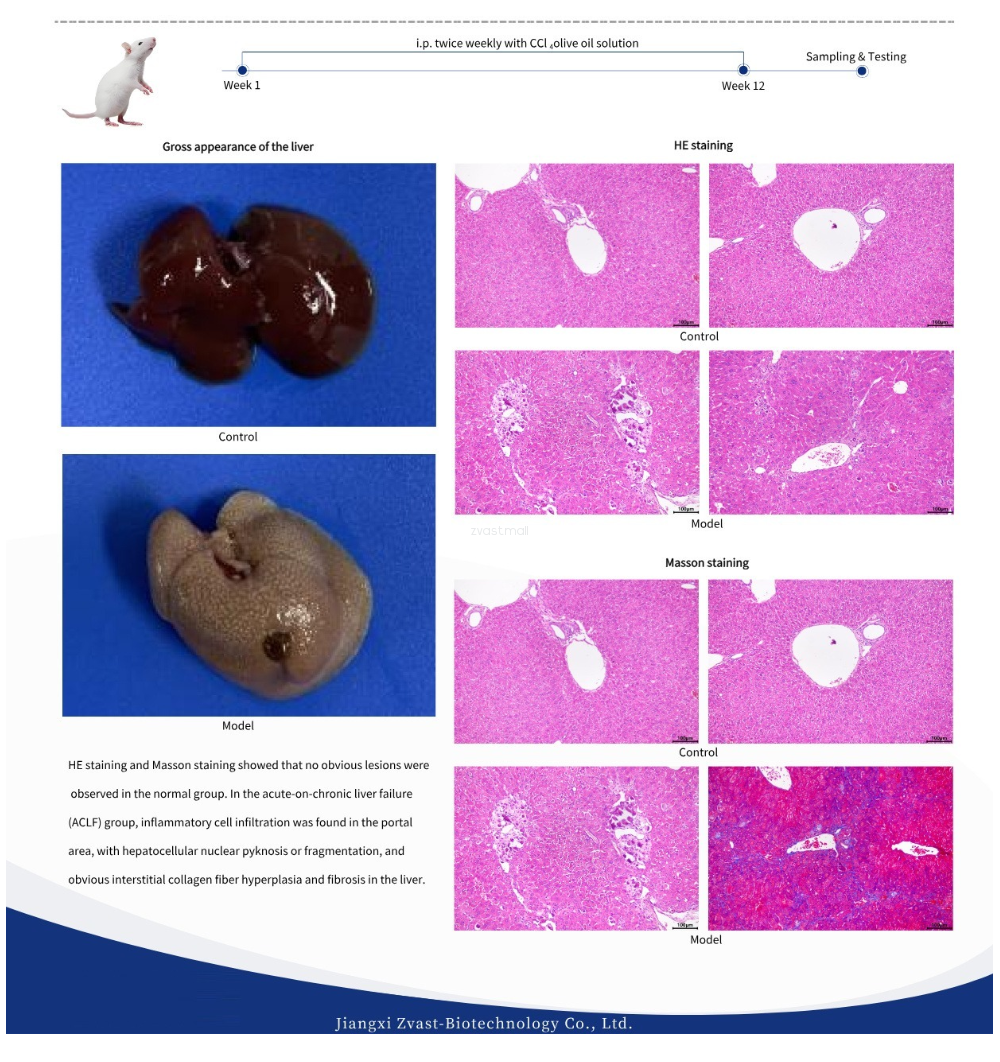
Compared with the blank control group, the model group shows extremely significantly elevated ALT and AST, indicating massive hepatocellular necrosis; sharply increased TBIL and DBIL suggesting severe jaundice; significantly decreased ALB indicating impaired hepatic synthetic function, which are the core biochemical criteria for ACLF modeling.
HE staining results show that on the basis of chronic liver injury, massive diffuse hepatocellular necrosis, severe destruction of hepatic lobule structure, extensive inflammatory cell infiltration, hepatic sinus congestion and dilation, and obvious hemorrhagic foci are observed, with partial hepatocellular apoptosis and patchy necrosis, which fully conform to the typical pathological characteristics of acute-on-chronic liver failure, confirming successful modeling.
Model Advantages
Adopting a two-stage modeling strategy of chronic injury plus acute insult, this model fully fits the clinical pathogenesis of ACLF, which is different from simple acute liver injury models. It has mature procedures, high reproducibility, high modeling success rate and controllable mortality. With stable pathological phenotypes, it integrates multiple characteristics including underlying liver fibrosis, acute inflammatory storm, massive hepatic necrosis and liver function failure. It is highly recognized in academia and suitable for SCI paper publication, ACLF mechanism research and efficacy evaluation of new hepatoprotective and anti-liver failure drugs.
Research Applications
The CCl4 combined with LPS/D-GalN induced mouse ACLF model is the most authoritative composite animal model for simulating acute-on-chronic liver failure. It is widely used in researches on ACLF pathogenesis, deterioration mechanism of chronic liver injury, hepatic inflammatory storm, hepatocellular necrosis and apoptosis, and hepatic immune disorder. It is applied to the efficacy screening and target mechanism verification of traditional Chinese medicines, natural products, chemical drugs and biological agents with hepatoprotective, anti-inflammatory, antioxidant, anti-necrotic and liver function-improving effects, serving as a core model for basic research and new drug development in the field of liver failure.