Position:Home >
ApoE-/- Knockout Mouse Atherosclerosis Model Induced by High-Fat Diet
ApoE-/- Knockout Mouse Atherosclerosis Model Induced by High-Fat Diet
Background
The ApoE-/- knockout mouse atherosclerosis model induced by high-fat diet is a globally recognized gold-standard animal model for cardiovascular pharmacology, atherosclerotic mechanism research and anti-atherosclerotic drug screening. Apolipoprotein E (ApoE) is a core gene regulating lipoprotein transport, reverse cholesterol transport and lipid metabolic homeostasis. ApoE gene knockout causes congenital defects in lipid metabolism, resulting in impaired clearance of low-density lipoprotein and chylomicron remnants, and spontaneous persistent hyperlipidemia and hypercholesterolemia in mice. Long-term high-fat and high-cholesterol diet further exacerbates lipid metabolic disorders, triggers vascular endothelial oxidative damage, endothelial dysfunction, vascular wall lipid infiltration, inflammatory cell adhesion and aggregation, and massive foam cell formation. It gradually induces aortic lipid streaks, fibrous plaques and atherosclerotic vulnerable plaques, fully recapitulating the complete pathological progression of human diet-induced atherosclerosis, including lipid deposition, endothelial injury, chronic vascular inflammation and plaque remodeling.ApoE knockout mouse atherosclerosis model,high-fat diet induced atherosclerosis,vascular atherosclerotic plaque model
Materials and methods
SPF-grade homozygous ApoE-/- knockout mice with C57BL/6 background at 8 weeks old are used in the experiment. Male mice are preferred due to faster plaque progression and higher model stability. All mice are housed in an SPF barrier system with constant temperature and humidity, 12 h light/dark cycle, and ad libitum access to food and water. After one week of adaptive feeding, formal high-fat modeling is initiated.
Test and verify
Modeling Success Criteria
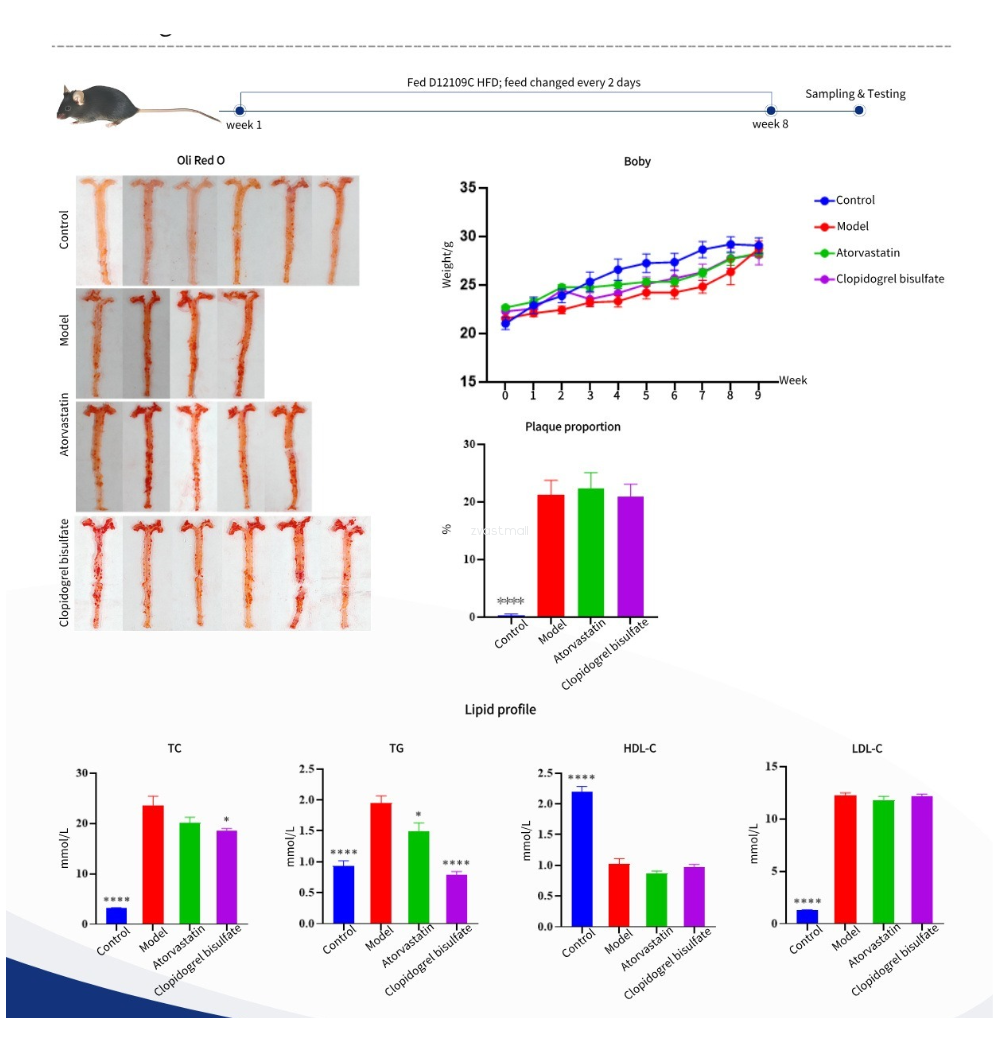
After modeling, the body weight of ApoE-/- mice is significantly higher than that of the control group, with typical lipid accumulation and hypermetabolic phenotype, consistent with the characteristics of hyperlipidemia combined with vascular lesions.
Compared with wild-type controls, the model group shows extremely elevated total cholesterol (TC), triglyceride (TG) and low-density lipoprotein (LDL-C), and significantly decreased high-density lipoprotein (HDL-C), forming typical hyperlipidemia disorder, which is the core biochemical basis for plaque formation.
Gross oil red O staining of the aorta shows large-area red lipid plaque deposition. HE staining of the aortic root reveals endothelial damage, lipid infiltration, foam cell accumulation, intimal thickening, lipid streaks and typical atherosclerotic plaque structure. Obvious plaque protrusion and lipid necrotic core formation in the aortic valve region confirm successful atherosclerosis modeling.
Model Advantages
ApoE-/- mice have congenital lipid metabolism defects with nearly 100% modeling success rate, high stability and excellent reproducibility. The modeling operation is simple without surgical intervention and has low mortality. Plaque progression is gradual, covering lipid streaks, fibrous plaques and vulnerable plaques, which highly simulates the complete course of human atherosclerosis. With high academic recognition, it is widely used in SCI paper publication, new drug application and in-depth mechanistic research, serving as the most authoritative atherosclerotic animal model in cardiovascular research.
Research Applications
The high-fat diet-induced atherosclerosis model in ApoE-/- mice is widely used in researching the pathogenesis of atherosclerosis, lipid metabolism disorder, vascular endothelial injury, chronic vascular inflammation, foam cell formation and plaque stability. It is applied to the pharmacodynamic evaluation and target mechanism verification of lipid-lowering, anti-inflammatory, antioxidant and endothelial-protective traditional Chinese medicines, natural products, chemical drugs and biological agents. It is a core standard model for basic cardiovascular research and new drug development against atherosclerosis.