Position:Home >
17α-Ethinylestradiol (EE)-Induced Rat Cholestatic Liver Injury Model
17α-Ethinylestradiol (EE)-Induced Rat Cholestatic Liver Injury Model
Background
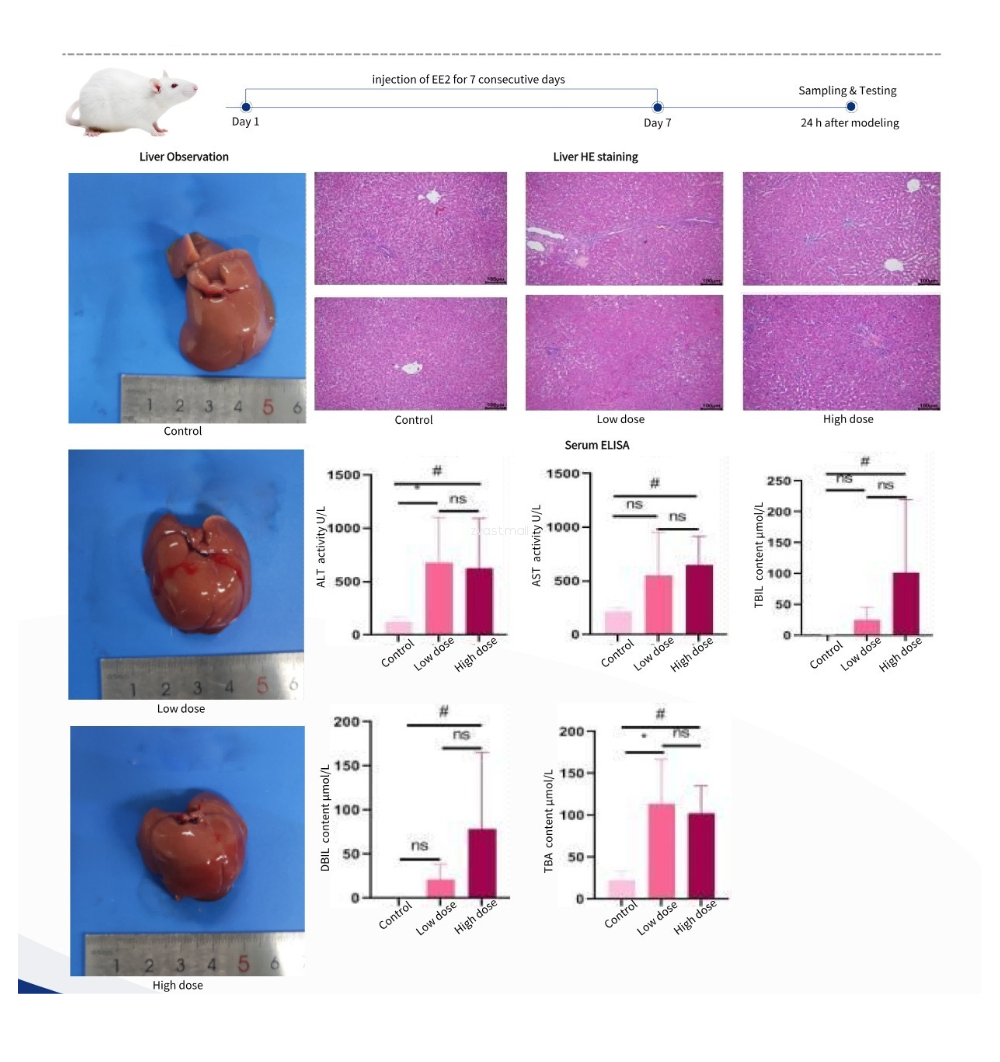
17α-Ethinylestradiol (EE)-induced rat liver injury model is a gold-standard drug-induced intrahepatic cholestasis animal model in hepatopharmacology and toxicology research, widely used for the development of hepatoprotective and choleretic drugs and the exploration of cholestasis pathogenesis. As a synthetic estrogen, 17α-Ethinylestradiol specifically binds and activates hepatic ERα receptors in rats, significantly downregulates the transcriptional and translational expression of core hepatic bile acid transporters includingBSEP, MRP2 and NTCP. It blocks the uptake, intracellular transport and canalicular excretion of bile acids in hepatocytes, leading to blocked bile acid metabolism and massive accumulation of toxic bile acids in liver tissues. Persistent intrahepatic cholestasis further induces hepatocellular oxidative stress damage, mitochondrial structural and functional disorders, inflammatory cell infiltration in hepatic portal areas, bile canaliculus dilation and characteristic bile plug formation, ultimately resulting in typical estrogen-mediated cholestatic liver injury. This model highly recapitulates the clinical liver damage caused by oral contraceptive abuse, endogenous estrogen metabolic disorder and intrahepatic cholestasis of pregnancy (ICP), serving as a core experimental model for simulating clinical non-infectious and metabolic cholestatic liver injury.
Materials and methods
SPF-grade SD rats or Wistar rats are used in this study. Male rats are preferred to avoid endogenous estrogen interference, ensuring stable modeling and low experimental variation. Rats are 8 weeks old with body weight of 200±20 g. All animals are raised under standard 12 h light/dark cycle, constant temperature and humidity, with free access to food and water, and adaptively fed for one week before modeling.
Test and verify
Model Advantages
The pathological phenotype is highly consistent with clinical intrahepatic cholestasis induced by estrogen, drugs and pregnancy; short modeling cycle, high stability and good reproducibility; highly specific cholestatic indicators, different from ordinary chemical liver injury; widely applicable to the efficacy evaluation and mechanism research of choleretic and hepatoprotective traditional Chinese medicine, natural products and chemical drugs.
This protocol features fast modeling, typical cholestatic phenotype and high repeatability, serving as the gold standard for hepatoprotective and choleretic drug screening and cholestasis mechanism research.