Position:Home >
6-OHDA-induced rat Parkinson\'s disease model
6-OHDA-induced rat Parkinson\'s disease model
Background
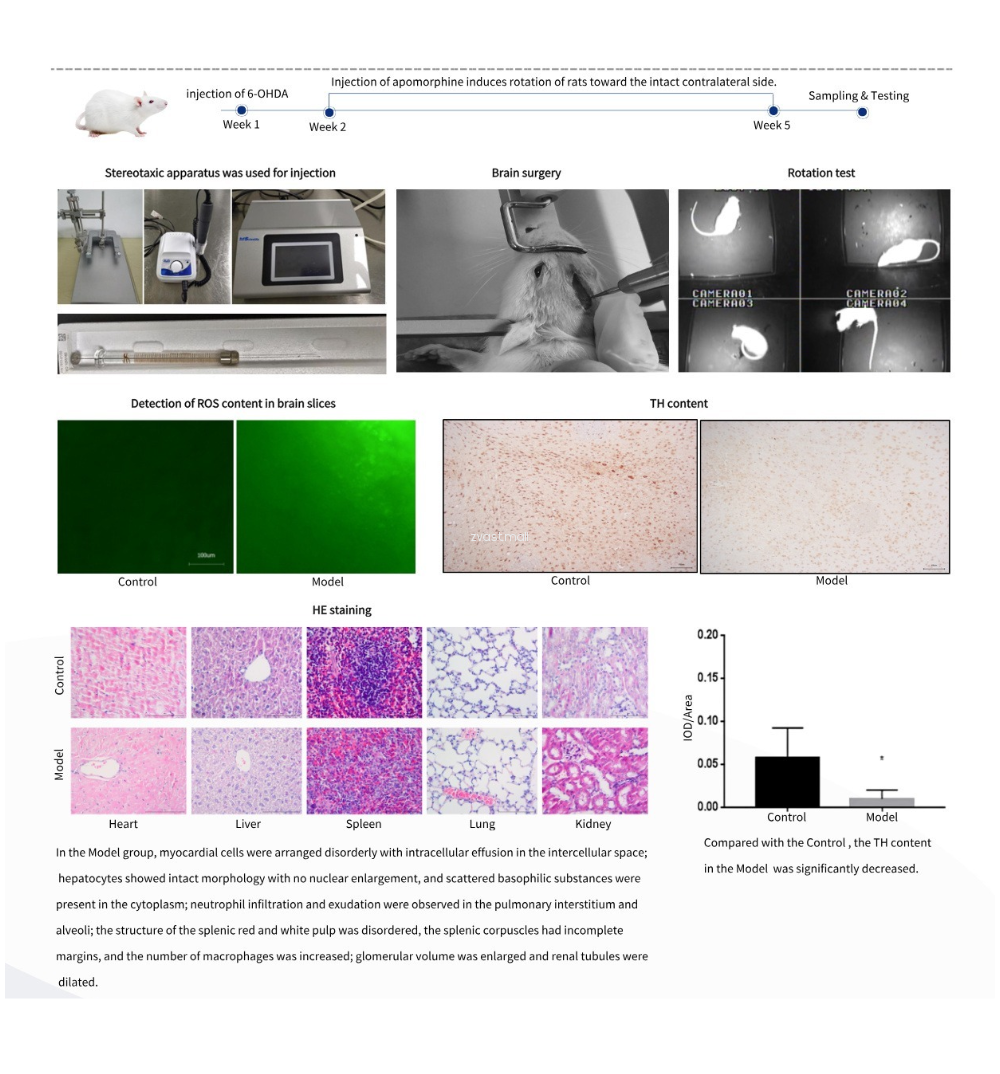
6-Hydroxydopamine (6-OHDA) has a similar structure to dopamine and can be actively taken up by dopaminergic neurons, selectively damaging and inducing apoptosis of dopaminergic neurons in the substantia nigra pars compacta (SNpc). This leads to depletion of dopamine (DA) in the striatum, simulating the core pathology of Parkinson\'s disease (PD): progressive loss of dopaminergic neurons in the SNpc, decreased striatal DA, bradykinesia, rigidity, and abnormal rotational behavior. Unilateral intracerebral stereotaxic injection is commonly used, with the modeled side damaged and the contralateral side as a control, resulting in obvious behavioral differences and easy evaluation of drug efficacy.
Advantages: stable modeling, good reproducibility, classic pathological phenotype, suitable for drug screening and mechanism research;
Materials and methods
SD rats / Wistar rats, weighing 180~220 g, male preferred (estrogen affects dopaminergic neurons).
Detection Indicators:1. Behavioral: APO rotation test, cylinder test, pole test, open field test; 2. Tissue immunohistochemistry: TH staining for counting dopaminergic neurons in the substantia nigra; 3. Biochemical: striatal DA neurotransmitters, SOD/MDA, inflammatory factors TNF-α/IL-6; 4. Molecular: expression of apoptosis, autophagy, and neuroprotection-related proteins.
Detection Indicators:1. Behavioral: APO rotation test, cylinder test, pole test, open field test; 2. Tissue immunohistochemistry: TH staining for counting dopaminergic neurons in the substantia nigra; 3. Biochemical: striatal DA neurotransmitters, SOD/MDA, inflammatory factors TNF-α/IL-6; 4. Molecular: expression of apoptosis, autophagy, and neuroprotection-related proteins.
Test and verify
Application Scenarios:
Used for efficacy evaluation and mechanism research of traditional Chinese medicine/chemical drugs/natural products for neuroprotection, antioxidation, anti-inflammation, promotion of dopaminergic neuron repair, and improvement of motor disorders.